I need to tell you something that’s going to sound like a weird career move, because it was.
Three years ago, if you’d told me I’d be coaching men on ejaculation control, I would’ve laughed and probably been a little offended. I was a performance coach for endurance athletes. Marathoners. Cyclists. Triathletes. Guys who flew across the country to train with me during the off-season because I had a reputation for methods that were — I’ll be honest — a little unorthodox compared to what mainstream sports science was pushing at the time.
I had a master’s degree in kinesiology. I’d spent a decade studying how the nervous system regulates performance under extreme physical stress. I knew more about vagal tone, sympathetic activation thresholds, and diaphragmatic breathing patterns than anyone at a dinner party would ever want to hear about.
And then a client named Marcus changed everything.
Marcus was 38, a competitive cyclist, solid athlete. We’d been working together for about four months on his pacing strategy for a century ride (a 100-mile cycling event). He’d made serious gains. His heart rate variability was improving. His lactate threshold had shifted. He was learning to stay in his parasympathetic zone longer under load, which is the whole game in endurance — how long can you delay the point where your sympathetic nervous system takes over and your body starts burning itself out?
One Tuesday after a training session, Marcus was packing up his stuff and said, without looking at me: “Hey, can I ask you something that has nothing to do with cycling?”
Then he told me he’d been struggling with premature ejaculation for the past two years. That it was destroying his marriage. That he’d tried numbing sprays, “thinking about baseball,” and a disastrous experiment with an SSRI that killed his libido entirely. That he was at the point where he was avoiding sex because the anxiety of failing again was worse than not having it.
And then he said something that I have never forgotten:
“The breathing stuff we do for cycling — the parasympathetic training, the heart rate control — could any of that work for… this?”
I didn’t know. But the more I thought about it that night, the more obvious it became that the answer was yes. Not theoretically. Not as a stretch. The overlap was so direct it was almost embarrassing that I hadn’t seen it before.
Contents
The Crossover That Was Hiding in Plain Sight
Here’s what I knew from a decade of endurance coaching, stated as plainly as I can:
The central challenge of endurance athletics is delaying sympathetic nervous system dominance.
Your autonomic nervous system has two gears. Parasympathetic — the calm, efficient, sustainable gear. And sympathetic — the fight-or-flight, all-out, burning-through-resources gear. In a marathon, the runners who perform best are the ones who stay in parasympathetic mode the longest. They keep their heart rate controlled, their breathing steady, their muscles relaxed, their mental state calm. The moment the sympathetic system takes over — heart rate spikes, breathing goes ragged, muscles tense, cortisol floods — performance starts deteriorating rapidly. The whole game is: how long can you delay that takeover?
Now think about premature ejaculation.
The central challenge of lasting longer in bed is delaying sympathetic nervous system dominance.
Same two gears. Same takeover dynamic. When you’re in parasympathetic mode during sex — breathing slow, muscles relaxed, heart rate steady — your erection is maintained and ejaculation is nowhere near the horizon. The moment the sympathetic system takes over — breathing goes fast and shallow, muscles tense (especially the pelvic floor), heart rate climbs — the ejaculatory reflex fires and the session is over.
It’s the same system. The same nervous system. Governed by the same neurotransmitters. Regulated by the same breathing patterns. Disrupted by the same psychological triggers. Trained by the same methods.
I sat with that realization for about a week. Then I called Marcus and said, “I have an idea that might sound insane.”
Marcus: The First Experiment
I want to be clear about something: what I did with Marcus initially was sloppy. I didn’t have a protocol for sexual performance. I had a protocol for keeping cyclists in zone 2 for six hours straight, and I adapted it on the fly. Some of it worked immediately. Some of it was completely wrong and I had to scrap it. I’m going to tell you about both, because the mistakes are where I learned the most.
What worked right away: Breathing. Marcus already knew diaphragmatic breathing from our cycling work — slow belly breaths, 3-4 seconds in, 4-5 seconds out, parasympathetic activation. When he started using this during sex, he told me the difference was noticeable on the first night. Not transformative, but noticeable. He went from lasting maybe 2-3 minutes to about 5-6 minutes. Just by breathing the same way he breathed on the bike.
I also taught him thrust-synchronized breathing — exhaling on the in-stroke, inhaling on the pull-back. This is adapted from how I teach runners to coordinate breathing with cadence. In running, exhaling on the foot strike reduces impact stress. In sex, exhaling during the moment of greatest stimulation relieves pelvic pressure. Same principle, different application. Marcus reported this added another minute or two within the first week.
What I got wrong: Kegels. I made the mistake that every trainer makes when they first encounter pelvic floor work — I told Marcus to do kegels to strengthen his PC muscle, assuming more strength = more control. Basic exercise science logic, right? Stronger muscles perform better.
Wrong. Two weeks into the kegel program, Marcus was worse. Significantly worse. He texted me at 11pm on a Thursday night: “Dude, I think the kegels are making this worse. I’m finishing faster than before we started.”
I had to go back to the research, and that’s when I discovered something that completely changed my approach: many men with PE already have a hypertonic pelvic floor (a pelvic floor that’s chronically over-tight, partially contracted even at rest). Telling these men to do kegels — to clench an already clenched muscle — is like telling someone with a permanent fist to do grip exercises. It makes the problem worse because it shortens the distance between “resting state” and “full contraction that triggers ejaculation.”
What Marcus needed wasn’t more strength. He needed reverse kegels — learning to actively relax and open his pelvic floor. The opposite of what I’d prescribed.
The moment I switched him to a reverse-kegel-dominant program — about 60% reverse kegels, 40% regular — things started moving fast. Within three weeks, Marcus was consistently lasting 12-15 minutes. Within six weeks, he texted me a message I still have saved: “We went 25 minutes last night. She asked if I was on something. I told her I was doing bike training exercises. Which is technically true.”
That was the moment I knew I’d stumbled onto something real.
The Dopamine Connection Nobody Talks About
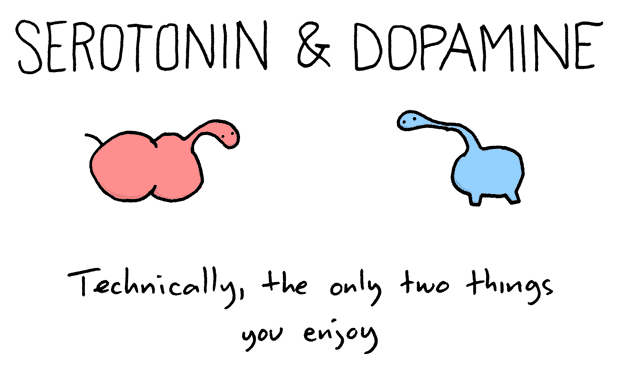
Once Marcus’s results started coming in, I went deep into the neuroscience of why the endurance-to-bedroom crossover works so well. And the answer kept coming back to dopamine.
In sports performance, dopamine is massive. It’s the neurotransmitter that governs motivation, reward processing, pain tolerance, effort perception, and thermoregulation. Research from the Vrije Universiteit Brussel has shown that athletes with higher dopamine activity can produce more work output and tolerate higher body temperatures while perceiving the effort as lower. Basically, dopamine is the chemical that makes hard things feel easier.
But here’s what made me sit up straight: dopamine plays the exact same role in sexual function. It drives arousal, desire, motivation, and — critically — it modulates the ejaculatory reflex. Low dopamine is associated with both low athletic motivation and sexual dysfunction. High dopamine is associated with both enhanced endurance and better ejaculatory control.
And exercise — particularly endurance exercise — is one of the most potent natural dopamine boosters available. A 2021 systematic review confirmed that regular exercise improves dopaminergic function across all age groups. Six weeks of high-intensity interval training increases dopamine D2 receptor density. Consistent aerobic exercise creates what researchers call a “hyperdopaminergic state” — your brain becomes better at producing and utilizing dopamine, not just during exercise, but all the time.
This is why athletes who maintain regular training often have better sexual stamina than sedentary men. It’s not just fitness. It’s neurochemistry. Their brains are literally producing more of the chemical that governs sexual control.
The flip side of this coin is ugly and I’ve seen it play out with three clients now: men who were getting their dopamine primarily from pornography. The dopamine system doesn’t care where its hits come from, and porn delivers massive, repeated, zero-effort dopamine spikes that gradually downregulate your dopamine receptors. Your brain becomes less sensitive to dopamine over time. This manifests as needing more extreme content to feel the same arousal (classic tolerance pattern, identical to what you see with any addictive substance), and — here’s where it connects to PE — a hair-trigger ejaculatory reflex because the desensitized system overreacts to real physical stimulation when it finally encounters it.
One of those three clients, a guy I’ll call Devon, was 26 and had been watching porn daily since he was 14. He could barely last 60 seconds during sex but could masturbate to pornography for 30-40 minutes. Classic dopamine desensitization pattern. The solution wasn’t more kegels or breathing work. It was a 90-day elimination of pornography combined with structured edging practice using physical sensation only. No screens. Devon called it “the most boring three months of my life” but by month two he was lasting 8-10 minutes during sex. By month three, 15+. His dopamine receptors were re-sensitizing, and his ejaculatory threshold was rising with them.
You can’t talk about dopamine without talking about testosterone, because they’re wired together in ways that are directly relevant to both athletic and sexual performance.
Testosterone upregulates dopamine receptor density. Higher testosterone = more dopamine receptors = better dopamine signaling = better motivation, better effort tolerance, better ejaculatory control. Dopamine, in turn, stimulates the hypothalamic-pituitary-gonadal axis (the hormonal cascade that tells your body to produce testosterone). They feed each other in a loop. When one goes up, the other tends to follow. When one crashes, it drags the other down.
This loop explains something I’d observed with my athletic clients for years without fully understanding it: the guys who were overtraining — cortisol through the roof, testosterone suppressed, terrible sleep, chronically fatigued — were also the ones who mentioned (if they mentioned it at all) that their sex drive was in the dumpster and when they did have sex, they either couldn’t maintain an erection or finished embarrassingly fast.
It wasn’t two separate problems. It was one problem expressing itself in two arenas.
When I started working with sexual performance clients specifically, I began tracking this correlation more carefully. I keep a spreadsheet — nothing fancy, just a Google Sheet — with anonymized client data: training frequency, sleep hours, self-reported stress level, estimated testosterone markers (morning erection frequency and quality, which is a surprisingly reliable proxy), and sexual performance metrics. The pattern in the data is unmistakable: clients who maintain 4-5 days of moderate exercise per week, sleep 7+ hours, and manage stress consistently outperform clients who train sporadically or are chronically under-recovered. Not by a small margin. By a massive margin.
There’s a client I worked with — I’ll call him Ryan, 44 years old, tech executive, classic burnout profile. He came to me specifically for PE. He was lasting about 90 seconds. His morning erections had been absent for months. He was sleeping 5 hours a night, drinking 4 cups of coffee by noon, hadn’t exercised consistently in two years, and was running on adrenaline and anxiety all day.
I didn’t start with breathing techniques or PC muscle work. I started with the unsexy stuff: 30 minutes of moderate cardio 4 days a week. Lights out by 10:30pm. Magnesium glycinate before bed. Sunlight exposure within the first 30 minutes of waking.
Ryan thought I was dodging his actual problem. “I came to you because I can’t last in bed and you’re telling me to go for walks and take magnesium?”
Four weeks later, his morning erections were back. His energy had stabilized. His afternoon anxiety had dropped noticeably. He reported feeling “less wired” in general. And — without any direct sexual performance work — he was already lasting about 3-4 minutes instead of 90 seconds. Just from the lifestyle baseline.
Then we layered in the breathing, the reverse kegels, the arousal scale training, the edging protocol. By week 8, he was at 15 minutes. By week 12, he was consistently going 20+ minutes and had experienced his first non-ejaculatory orgasm during a solo session.
Ryan’s case taught me something I now tell every client on day one: if your testosterone-dopamine system is suppressed from lifestyle factors, no amount of technique will fully compensate. You need the neurochemical foundation before the techniques can do their job. It’s like trying to tune a guitar that has no strings.
The Breathing Thing That Runners Already Know (And Bedroom Coaches Don’t Teach)
This is the part where being an endurance coach gave me an unfair advantage over every sex therapist I’ve ever read.
Most PE advice about breathing is maddeningly vague. “Take deep breaths.” “Breathe slowly.” “Try to relax.” That’s like telling a marathon runner “try to run at a comfortable pace.” It’s technically not wrong, but it’s useless without specifics.
From endurance training, I knew that breathing is the only autonomic function you can control manually. Your heart rate? You can’t slow it with a thought. Your digestion? Automatic. But breathing? You can take over from the autopilot at any moment and directly manipulate your nervous system state through rate, depth, and pattern.
Specific patterns do specific things. I tested five different breathing protocols with clients over a six-month period, tracking which ones produced measurable changes in time-to-ejaculation during solo practice sessions. The results surprised me.
Box breathing (4 seconds in, 4 hold, 4 out, 4 hold) was the best pre-sex calming method. Two minutes of box breathing before an encounter consistently dropped clients’ starting arousal level by 1-2 points on the 10-point scale I use. Guys who were walking into the bedroom pre-loaded at arousal level 5-6 from anxiety were starting at level 2-3 instead. That extra headroom alone was adding 3-5 minutes.
Extended exhale breathing (3 seconds in, 6 seconds out — a 1:2 ratio) was the strongest daily training method. The science is clean on this: during exhalation, your heart rate drops slightly due to something called respiratory sinus arrhythmia. By making the exhale twice as long as the inhale, you spend two-thirds of every breath cycle in heart-rate-lowering, parasympathetic-activating mode. Five minutes a day of this was producing measurable changes in baseline vagal tone within 3-4 weeks. Runners and cyclists who did this saw better heart rate recovery. Sexual performance clients saw improved ejaculatory control. Same mechanism, different arena.
Thrust-synchronized breathing (exhale on the in-stroke, inhale on the pull-back) was the most immediately impactful during-sex technique. The reasoning comes directly from running science: inhalation creates pressure in the lower abdomen and pelvic area. During running, this pressure increases impact forces. During sex, it pushes against the prostate and PC muscle, which can trigger the ejaculatory reflex. Exhaling during the moment of greatest stimulation relieves that pressure. Most men naturally do the opposite — they gasp inward during the thrust — and reversing this pattern alone added 2-4 minutes for the majority of clients I tracked.
I don’t recommend all five techniques at once. That’s a mistake I made early on with a client named Tyler, 31, who was so enthusiastic about the breathing work that he tried to implement box breathing, extended exhale, and thrust-synchronized breathing all on the same night. He got so focused on counting seconds and coordinating patterns that he lost his erection entirely. His girlfriend thought he was having a panic attack. “She literally asked me if I was okay because I was breathing like I was doing Lamaze,” he told me afterward, which was genuinely funny in hindsight but not in the moment.
The lesson: I now introduce one breathing technique per week. Box breathing first (pre-sex calming). Extended exhale second (daily training). Thrust-synchronized third (during sex). By the time you’re using all three, each one has become automatic enough that you’re not thinking about it — you’re just doing it.
The Pelvic Floor Revelation That Changed My Entire Practice
I’ve already told you about the Marcus kegel disaster. But it took two more clients having the same experience before I fully committed to the reverse-kegel-first approach.
The problem with mainstream PE advice is that it treats the pelvic floor like a bicep — something you make stronger and everything gets better. But the pelvic floor is more like a hamstring. Yes, it needs to be strong. But if it’s chronically tight and can’t relax on demand, strength becomes a liability. A sprinter with tight hamstrings doesn’t need more hamstring curls. They need stretching and release work. Same principle applies to the PC muscle.
I now start every client with a simple assessment. I have them do a PC squeeze and hold for 30 seconds, then I have them do a reverse kegel — push downward and outward, as if gently beginning to urinate — and hold for 10 seconds. If they can squeeze easily but struggle with the reverse (and about 70% of PE clients do), I know their pelvic floor is hypertonic and we need to prioritize relaxation before strength.
For those clients, the first two weeks are reverse kegels only. No standard kegels at all. Front reverse kegels (pushing outward at the base of the penis) and back reverse kegels (gentle push downward at the perineum). Light force — never straining. 10-second holds, 10 reps, once a day. That’s it.
The results from this seemingly minimal intervention are consistently the most dramatic of anything I do. Clients who were lasting 2-3 minutes report jumping to 5-7 minutes within two weeks — before we’ve even introduced breathing techniques or arousal control. Just by teaching their pelvic floor to stop being clenched all the time.
Once the baseline relaxation is established, then I layer in standard kegels for strength. But always at a 60:40 ratio — 60% reverse kegels, 40% regular. Always preceded and followed by reverse kegels as warm-up and cool-down. And never — I’m emphatic about this with clients — never doing kegels during sex. During sex, the pelvic floor should be relaxed as a default. The only time you deliberately squeeze during sex is the emergency PC clamp at the point of no return, and that’s a specific, trained technique, not general flexing.
If you’re reading this and you’ve been doing kegels for months with no improvement — or if things have gotten worse — try two weeks of reverse kegels only and see what happens. I’d bet a lot of money that your pelvic floor is already strong enough. It just doesn’t know how to let go.
The Technique That Made Me Rethink What’s Possible
About eight months into this work, I came across Dr. Barbara Keesling’s clinical research on non-ejaculatory orgasm. And I’m going to be honest — my first reaction was skepticism bordering on eye-rolling. Orgasm without ejaculation? Multiple male orgasms? It sounded like late-night infomercial territory.
Then I read the actual clinical protocols. And then I tested them with three clients who had strong enough PC muscles and good enough arousal awareness to attempt it.
The first client to successfully pull it off was a guy named James, 35, who’d been doing PC muscle work for about five weeks. He was doing a solo edging session — extended stimulation at arousal level 5-7, which we’d been practicing — and he let himself climb to level 9 intentionally, then squeezed his PC muscle at maximum intensity at the precise moment the orgasmic contractions started.
He felt the orgasm. The rhythmic contractions. The pleasure waves. But nothing came out. His erection stayed. He waited 30 seconds, resumed, and continued for another 15 minutes before choosing to finish with a full ejaculatory orgasm.
His text to me was five words: “Holy shit it actually works.”
I’ve since guided about a dozen clients through the NEO protocol. The success rate isn’t 100% — it takes genuine PC muscle strength (you need to be able to hold a maximum squeeze for 15+ seconds), precise timing (the squeeze window is about 2-3 seconds wide), and the correct direction of squeeze (upward/inward, not forward/pushing). Maybe 60-70% of clients who attempt it successfully achieve it within 2-3 weeks of trying. The other 30-40% either don’t have the PC strength yet or can’t nail the timing — and I send them back for more foundational work before reattempting.
I don’t position NEO as the goal for every client. For a lot of guys, lasting 15-20 minutes instead of 3 is a life-changing improvement and they’re done, they’re happy, they don’t need to pursue multiple orgasms. But for the clients who want to go further, knowing that it’s physiologically real — not woo-woo, not tantric mysticism, but a documented clinical technique with a specific muscular mechanism — changes their entire relationship with their body’s sexual responses.
What I’ve Learned After 40+ Clients
I keep that spreadsheet I mentioned. Forty-something entries now, spanning ages 23 to 56. Here are the patterns that keep showing up, regardless of age or baseline:
The lifestyle foundation matters more than technique. Clients who exercise regularly, sleep 7+ hours, and have manageable stress levels improve roughly twice as fast as clients who don’t. I’ve stopped being subtle about this. If a guy comes to me sleeping 5 hours a night and running on caffeine, we fix that before I teach him a single breathing exercise. Technique layered on top of a broken neurochemical foundation is like building a house on sand.
Reverse kegels produce faster initial results than any other single intervention. For men with hypertonic pelvic floors — which is the majority of PE clients — two weeks of reverse-kegel-only work adds 3-5 minutes before anything else is introduced. I don’t fully understand why this isn’t the default first-line recommendation everywhere. The research supports it. My client data supports it. Yet most PE resources still lead with standard kegels, which is actively harmful for this population.
Pornography use is the strongest negative predictor of progress. Clients who consume pornography regularly during the training program improve at roughly half the rate of clients who don’t. The three clients who made the least progress in my tracking sheet were all daily porn users who weren’t willing to stop. I’m not making a moral judgment — I’m reporting what the data shows. Dopamine desensitization from high-stimulation visual content directly undermines the neurochemical retraining that the program relies on. I now ask about porn use in the intake conversation and recommend elimination during the training period as strongly as I can without being preachy about it.
The partner conversation is the highest-leverage psychological intervention. Clients who have an open conversation with their partner about what they’re working on — what they’re doing, why they might pause during sex, what they need from her — improve faster and sustain their gains more reliably than clients who try to implement techniques secretly. The anxiety of hiding the effort is itself a sympathetic nervous system trigger. Removing the secrecy removes a major source of the performance anxiety that causes PE in the first place.
The average time from starting the program to reaching “satisfactory” sexual duration (self-defined by the client) is 6-8 weeks. Not instant. Not magic. Six to eight weeks of consistent daily practice — 15-20 minutes of meditation, breathing, and PC work per day, plus 2-3 edging sessions per week. The clients who treat it like a training program (which it is) get the results. The clients who treat it like a pill they take once and wait for it to kick in get nothing.
Why I’m Still Doing This
I still train athletes. That hasn’t changed and probably never will — it’s where I started and it’s what I love. But the sexual performance work has become something I didn’t expect: the most meaningful coaching I do.
A cyclist who shaves 30 seconds off their century time is happy for a weekend. A man who goes from dreading intimacy to looking forward to it — who watches his relationship transform because the shame and avoidance are gone — that changes a life. I’ve had clients tell me that our work saved their marriage. I’ve had guys in their 20s tell me they’d been avoiding relationships entirely because they were so afraid of the PE conversation. I’ve had a 52-year-old man cry during a check-in call because he’d lasted long enough for his wife to orgasm during intercourse for the first time in their 18-year marriage.
That doesn’t happen in cycling.
The science is the same science I’ve always used. Nervous system regulation. Breathing physiology. Muscular conditioning. Dopamine optimization. Parasympathetic training. The body doesn’t know the difference between a bike ride and a sexual encounter — it runs the same operating system for both.
The only thing that changed is where I applied it.